

One of the funniest things about the relocation business is how often people compare moving costs.
A customer will call Pradhan Packers and Movers and say, “My cousin shifted his entire house for ₹15,000. Why is my quotation different?”
On paper, it sounds like a fair question.
Both are moving within India. Both have families. Both live in apartments.
But the moment our survey team visits the property, the answer usually becomes obvious.
One home has a sofa, two beds, a dining table, and a few appliances. The other has three wardrobes packed with years of belongings, a modular workstation, a treadmill that hasn’t been used since lockdown, and enough cartons in the loft to fill half a truck.
That’s the thing about relocation. Most people see only the destination. Movers see everything that happens between the old front door and the new one.
And that’s exactly where the cost comes from.
Table of Contents
ToggleThe Distance is Important, But it’s Rarely the Whole Story
Most people immediately think about kilometres.
If you’re moving from Kolkata to Delhi, the cost will obviously be higher than moving from Salt Lake to New Town. Nobody argues with that.
What people don’t always realise is that distance affects much more than fuel.
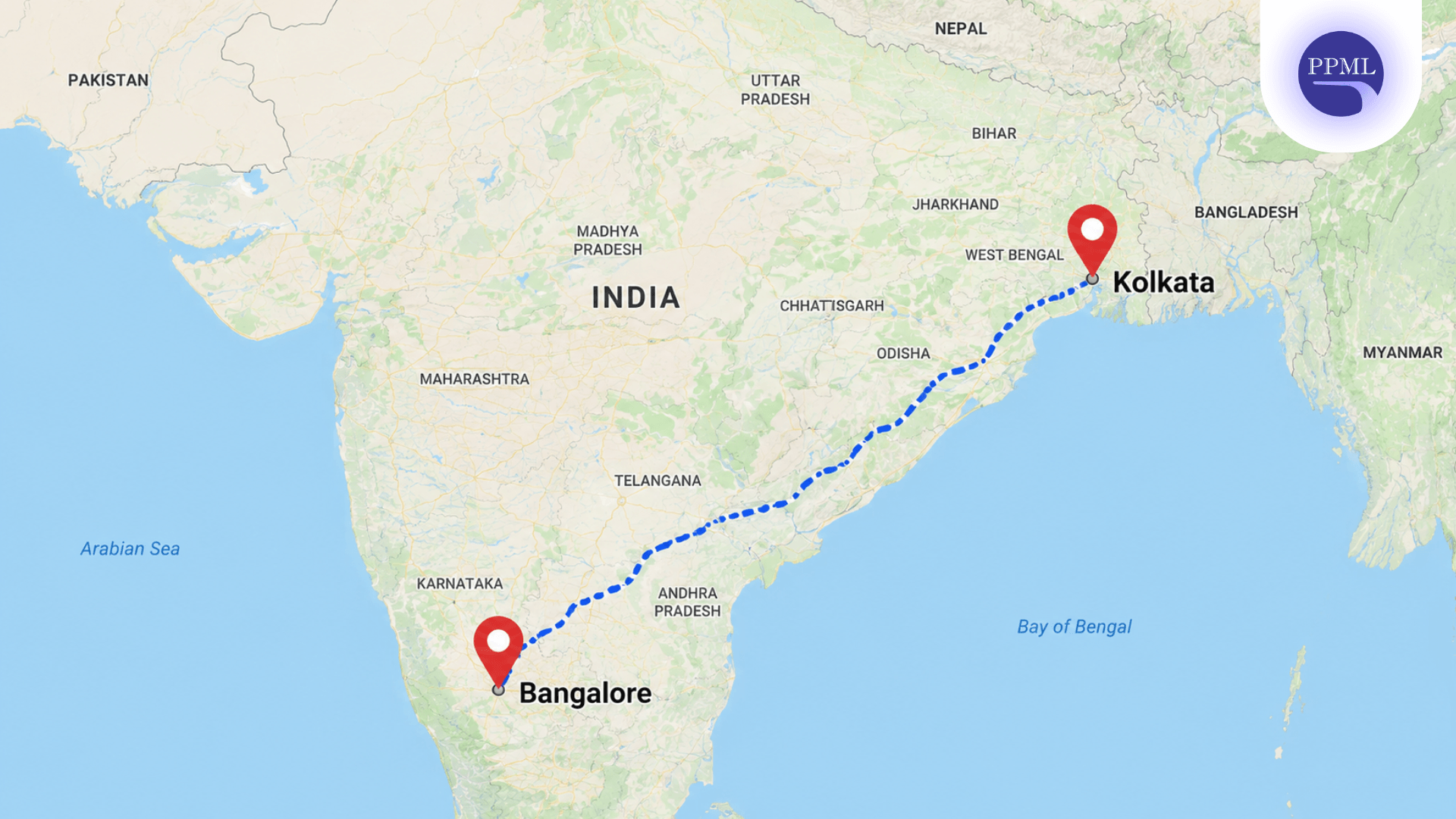
A long-distance move means tolls, driver allowances, overnight halts, route planning, interstate documentation, vehicle scheduling, and transit coordination. A truck carrying household goods from Kolkata to Bangalore doesn’t simply start and stop. There is an entire logistics chain working behind the scenes.
At the same time, we’ve seen local moves become surprisingly complicated.
A customer may be shifting only eight kilometres away, but if the truck cannot enter the lane, the team may need to manually carry furniture for a considerable distance. Suddenly, what looked like a simple local relocation requires additional manpower and time.
So yes, distance matters.
But accessibility often matters just as much.
The House Size Doesn’t Matter as Much as What’s Inside It
This surprises people during surveys.
Customers often describe their move by saying, “It’s just a 2 BHK.”
But a 2 BHK can mean completely different things.
We’ve entered homes where a family had recently moved in and owned only essential furniture. We’ve also entered similar-sized apartments where twenty years of accumulated belongings were stored in wardrobes, lofts, utility areas, balconies, and spare rooms.
The second home naturally requires more cartons, more wrapping material, more labour, and a larger vehicle.
Sometimes customers don’t even realise how much they own until packing starts.
Old books. Extra mattresses. Unused chairs. Seasonal decorations.
Storage boxes that haven’t been opened for years.
Every item requires handling. Every item occupies space.
And every item contributes to the final cost.
One practical piece of advice we often give customers is simple: before moving, decide what actually deserves to travel with you.
Many families end up paying to transport things they no longer use.
Good Packing Costs More – But Bad Packing Costs Even More
This is probably the most misunderstood part of house shifting.
Everyone wants safe transportation.
Nobody wants damaged furniture. Nobody wants a cracked television.
Nobody wants to unpack broken crockery at the destination.
But proper protection requires materials, time, and skill.
A glass dining table cannot be packed the same way as a carton of clothes. A large LED television needs different protection than a washing machine.
Imported furniture, artwork, mirrors, musical instruments, and fragile décor pieces all require specialised handling.
At Pradhan Packers and Movers, we’ve seen the consequences of poor packing far too often. Customers sometimes approach us after previous moving experiences where corners were cut to reduce costs. The immediate saving looked attractive, but the repair bills afterwards told a different story.
Good packing isn’t an additional expense. It’s often what prevents a much larger expense later.
Some Buildings Make Moving Surprisingly Difficult
This is one of those factors customers rarely think about until moving day.
A ground-floor house with parking right outside is relatively straightforward. An apartment with a service lift is usually manageable.
But older buildings can create challenges that significantly affect the workload.
We’ve handled relocations where large wardrobes had to be dismantled because they couldn’t fit through staircases. We’ve worked in buildings where the lift was unavailable for moving purposes. We’ve seen situations where heavy appliances had to be carried manually across multiple floors.
The furniture hasn’t changed. The destination hasn’t changed.
But the amount of effort required has changed dramatically.
When movers calculate quotations, they aren’t just looking at what is being moved. They’re also looking at how difficult it will be to move it safely.
A fourth-floor apartment without an elevator is a very different project from a modern residential tower with dedicated service access.
Timing Changes Prices More Than People Expect
If you’ve ever booked flight tickets, you already understand this concept.
The same principle exists in relocation. Certain periods are extremely busy.
Month-end dates. Weekends. Public holidays. Festival seasons. Corporate transfer cycles.
These periods see a sharp increase in relocation demand.
As a result, availability becomes tighter and scheduling becomes more competitive.
Customers who plan their move well in advance often have more flexibility. They can choose convenient dates, compare options, and avoid last-minute pressure.
On the other hand, urgent relocations usually require rapid resource allocation. Trucks, manpower, and packing teams may need to be rearranged at short notice.
Naturally, that affects pricing.
Good planning doesn’t guarantee the lowest rate. But it almost always provides better choices.
The One Factor Most People Ignore : Transparency
After years in this industry, we’ve noticed that customers aren’t usually upset about paying for genuine services.
They’re upset when unexpected charges appear later.
That’s why the quality of the quotation matters just as much as the amount.
A professional relocation estimate should clearly explain what is included.
Packing. Loading. Transportation. Unloading. Labour. Insurance. Taxes.
The more transparent the discussion is at the beginning, the smoother the relocation tends to be.
Most relocation disputes don’t start on moving day. They start much earlier when expectations and reality don’t match.
Final Thoughts
House shifting rates are influenced by far more than a truck and a distance chart.
The volume of belongings, the complexity of the property, the quality of packing, the relocation date, and the actual logistics involved all play a role in determining the final cost.
This is why two seemingly similar moves often receive very different quotations.
The goal shouldn’t be finding the cheapest number.
The goal should be understanding what that number includes.
A well-planned move with proper packing, experienced handling, and clear communication usually delivers far greater value than a low quotation that creates problems later.
At Pradhan Packers and Movers Pvt Ltd, we’ve learned that customers appreciate honesty more than surprises. When people understand how relocation pricing works, they can make informed decisions and move with confidence rather than uncertainty.
PEOPLE ALSO ASK
Every relocation has unique requirements. Distance, volume of goods, packing needs, floor level, access conditions, and timing all influence the final cost.
Yes. More belongings require additional packing materials, larger vehicle capacity, extra labour, and longer handling time.
A survey helps assess the actual volume of goods, identify logistical challenges, estimate packing requirements, and provide a realistic quotation.
In many cases, yes. Weekdays and mid-month dates often have lower demand compared to weekends and month-end periods.
For valuable, fragile, or long-distance relocations, professional packing significantly reduces the risk of damage during transportation.








Leave a Reply